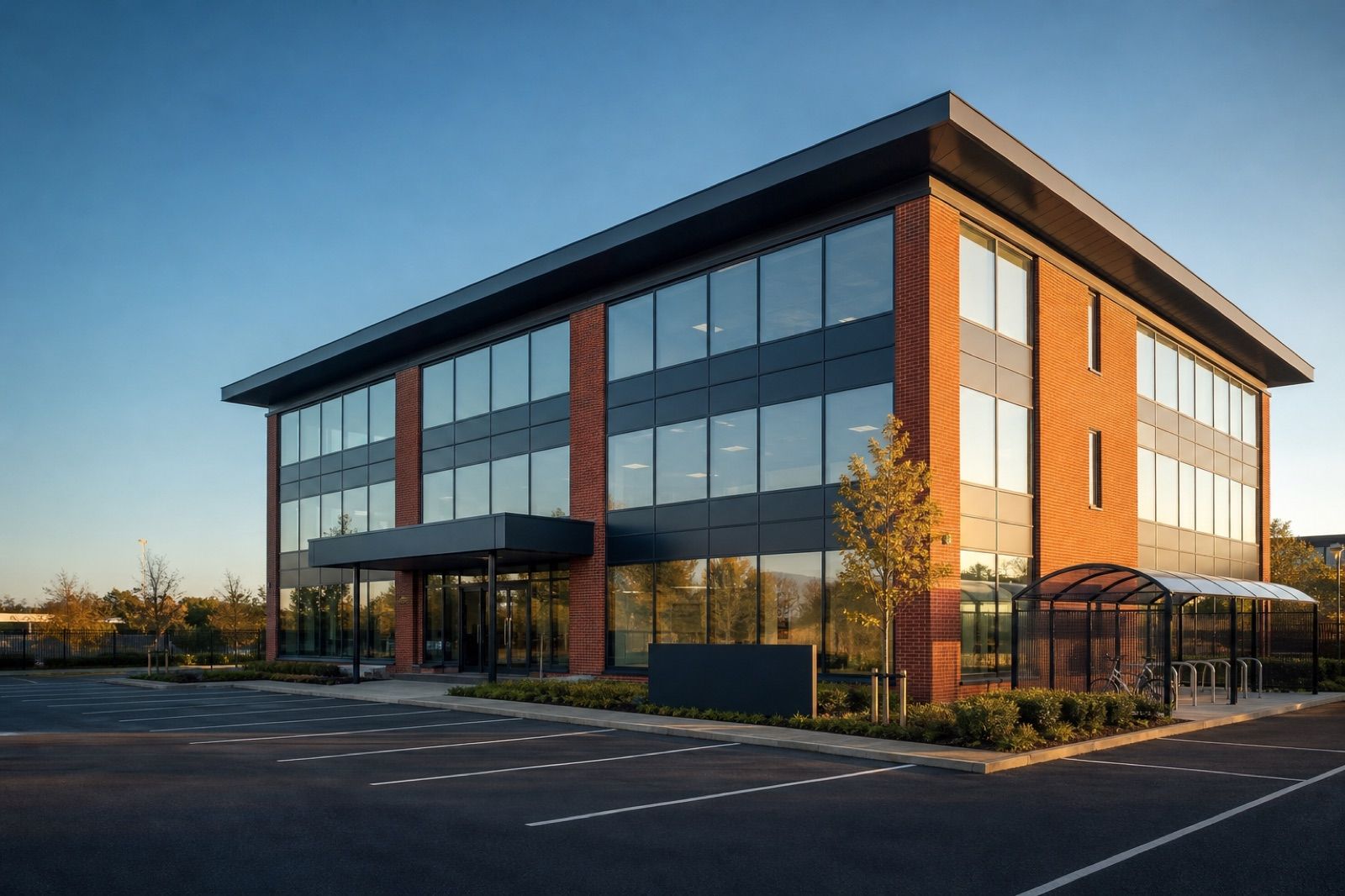
VAT on commercial property is value added tax charged when the seller of a non-residential building has opted to tax it, or when the building is new. In those cases 20% is added to the price, and on a £500,000 unit that is £100,000 of cash you need on completion day. Most buyers who are caught out had assumed commercial property is always exempt.
We arrange business mortgages for trading companies buying the premises they work from, and the VAT question comes up on a large share of those purchases. This guide covers when VAT applies, how the option to tax works, the rules for new buildings, the basics of a transfer of a going concern (TOGC), the knock-on effect on stamp duty, and how to fund the VAT. We checked the key points against HMRC's VAT Notice 742A (Opting to tax land and buildings) on gov.uk in October 2026. We are not tax advisers: your accountant or a VAT specialist should confirm the position on your purchase before you exchange.
- The sale of an older commercial building is exempt from VAT unless the seller has opted to tax it.
- A freehold sale of a commercial building within three years of its completion is always standard-rated, at 20%.
- A tenanted building sold with its lease can be a transfer of a going concern, outside the scope of VAT, if the buyer opts to tax and notifies HMRC in time.
- VAT charged on the price is included when SDLT, LBTT or LTT is calculated, even if you reclaim the VAT.
- Most lenders do not lend against the VAT, so it needs cash or a short-term bridging facility until HMRC repays it.
When is a commercial property sale exempt from VAT?
The starting point under UK VAT law is that the sale or letting of land and buildings is an exempt supply. This VAT exemption covers most second-hand commercial properties. If a business sells an office it has owned for twenty years and never opted, the property transaction is VAT-free and the buyer pays the agreed price.
Two things override the exemption and make the sale a standard-rated supply, so the seller must charge VAT:
- the seller, or a previous owner whose option still applies, has opted to tax the property; or
- the building is new, meaning a freehold sale within three years of completion.
Residential property sits outside this regime for real estate VAT purposes: the option to tax does not apply to a building intended for use as a dwelling. That matters for semi-commercial premises, where VAT may be charged on the shop but not on the residential property above it, and the price has to be split between the two parts.
The way to find out is simple: your solicitor asks the seller in pre-contract enquiries whether the property is opted, whether VAT will be charged, and whether the sale is intended to be a TOGC. Ask before an offer is agreed.
How does the option to tax work?
An option to tax is an election by the owner to tax the property, turning what would be exempt supplies into taxable ones. HMRC's VAT Notice 742A says that once you opt to tax, your supplies "will normally be standard-rated", and the standard rate of VAT is 20% (gov.uk, VAT rates).
Owners of commercial buildings opt mainly for VAT recovery: an opted owner can usually reclaim the input tax on costs such as building work, which would otherwise be lost. The price is that they must charge VAT to tenants on rent and on any sale of the opted building.
Key points from Notice 742A, verified on gov.uk in October 2026:
- The option is notified to HMRC, normally within 30 days of the decision.
- There is a cooling-off period of 6 months in which it can be revoked if conditions are met.
- After that, an option cannot normally be revoked until at least 20 years have passed.
- It does not apply to buildings intended for use as a dwelling, or where the buyer or tenant will use the building solely for a relevant charitable purpose.
The option attaches to the owner's interest, so when you buy an opted building the seller charges VAT on the price unless the sale is a TOGC.
The same rules explain VAT on commercial rent: if your landlord has opted to tax, the rent is standard-rated; if not, it is exempt.
New buildings under three years old
A new commercial building gets different VAT treatment. Notice 742A states that "a freehold sale of a commercial building within 3 years of its completion is always standard-rated". No option to tax is needed, and the seller cannot choose to sell it exempt.
This catches buyers of units on new business parks and recently completed offices. The three years run from completion of the building, not from when the seller bought it, so a unit that has changed hands once since it was built can still carry VAT. The rule applies to freehold sales; the grant of a lease of a new building follows the normal exempt-unless-opted position.
If you are buying off-plan or from a developer, expect the price to be quoted plus VAT and plan your funding around the higher figure from the start. Our guide to buying commercial property for your business covers the wider purchase process.
Transfer of a going concern: when no VAT is charged
A transfer of a going concern (TOGC) is the sale of a business, or part of one, as a going concern. In commercial property transactions this most often means a building sold with tenants in place and paying rent, so that the buyer takes over a property rental business. A TOGC is outside the scope of VAT, so no VAT is charged even though the building is opted.
For an opted building, Notice 742A section 11 sets two extra conditions for the buyer:
- the buyer must have opted to tax the property, with the option notified to HMRC and effective on or before the relevant date (normally the time the sale would otherwise take place, usually completion); and
- the buyer must notify the seller, by the same date, that the option will not be disapplied by the anti-avoidance rule.
The buyer must also be registered for VAT, or become a taxable person as a result of the transfer. If any condition fails, the sale is not a TOGC and the seller has to charge VAT.
However, for an owner-occupier this is less common than it sounds. A business buying a vacant building to trade from is not taking over a rental business, so there is no going concern TOGC, and VAT is charged if the building is opted. TOGC treatment is more likely where you buy a building that is partly let and keep the tenant. It needs careful drafting by your solicitor and accountant, ideally chartered accountants or tax firms with property VAT experience.
VAT inside the SDLT, LBTT and LTT calculation
VAT charged on the supply counts as part of the price for property tax purposes. HMRC's SDLT manual says chargeable consideration includes any VAT payable on the land transaction, even where the buyer can recover it. Revenue Scotland (LBTT) and the Welsh Revenue Authority (LTT) take the same approach.
Illustrative example. A business in England buys an opted office at £500,000 plus VAT at 20%, a total of £600,000. SDLT at the non-residential rates (HMRC, rates as at October 2026: 0% to £150,000, 2% from £150,001 to £250,000, 5% above £250,000) is £0 + £2,000 + £17,500 = £19,500. Without VAT it would be £14,500. You may reclaim the £100,000 of VAT, but the extra £5,000 of SDLT is a permanent cost.
A TOGC therefore saves stamp duty as well as cash flow. Our guide to stamp duty on commercial property sets out the rates in all four nations; check the current rates before you buy.
Can you reclaim the VAT on a premises purchase?
A VAT-registered business that uses the premises to make taxable supplies can usually reclaim the VAT on the purchase as input tax, through its VAT return. For a typical trading company, such as a manufacturer, wholesaler, retailer or engineering firm, the VAT is a timing cost rather than a real one.
Input tax recovery is restricted where the business makes exempt supplies. Dental and medical practices, insurance brokers and some financial services firms are largely or wholly exempt, so they may recover little or none of the VAT, and it becomes a true cost of the purchase. In that case it is worth asking whether the seller would sell without opting, or whether the deal can be restructured; our page on professional practice mortgages covers these buyers.
Larger property purchases can also fall within the Capital Goods Scheme, which adjusts the VAT recovered over a number of years if the use of the building changes. It can affect how much input tax you keep, so ask your accountant whether it applies.
Funding the VAT when the mortgage will not
Most lenders do not lend against the VAT, so it falls outside the mortgage finance. A business mortgage is sized on the net purchase price or valuation, whichever is lower, at typically 70 to 75% loan to value for owner-occupiers. The VAT sits on top of the deposit, the stamp duty and the fees, and must be paid on completion.
There are two ways to bridge the gap until HMRC repays the VAT through your next return:
- Cash: from reserves, if the business can spare it for one or two VAT quarters. Moving to monthly VAT returns can shorten the wait.
- A short-term facility: a bridging loan for business premises sized to cover the VAT, repaid when HMRC pays the reclaim. Indicative pricing is 0.70 to 0.95% a month, subject to status, accounts and valuation, and it adds arrangement and legal costs.
Either way, the lender will want to see where the VAT money is coming from before it issues an offer. Build it into the cash plan at the offer stage, alongside the figures on our costs page.
This guide is general information and not tax advice. Rates and rules as at October 2026; check the current position before you buy.