
A semi-commercial mortgage is a loan secured on a building that has a commercial part and a residential part under one title, most often a shop, practice or office on the ground floor with a flat above. Lenders also call it a mixed-use mortgage. This page is written for owner-occupiers: the trading business that wants to buy, or refinance, the premises it trades from, flat and all.
It is finance for a business's premises, not a residential mortgage for your home. That distinction matters, because the flat can change how the loan is treated. If you or a close family member will live upstairs, the loan can fall inside the FCA's definition of a regulated mortgage contract, and we refer those cases to an authorised firm. Most owner-occupier purchases in a limited company name do not, and those we arrange ourselves. Semi-commercial mortgages are a smaller corner of the market than standard commercial mortgages, so it pays to know which products exist before you apply.
Below we cover how lenders assess semi-commercial property finance for mixed-use properties, the regulated perimeter, indicative rates and lending criteria, and when bridging finance fits better than a term loan.
- A semi-commercial mortgage is one loan secured on a building with commercial space below and residential space above.
- Lenders assess the trading business on its accounts and value both the commercial and the residential parts.
- If at least 40% of the building is used as a dwelling and you borrow personally, the loan can be a regulated mortgage contract; we refer those cases to an authorised firm.
- Indicative terms: 6.5 to 8.5% a year, up to 75% loan to value, subject to status, accounts and valuation.
- Bridging finance can bridge a purchase that needs work before a term lender will lend on it.
What is semi-commercial property?
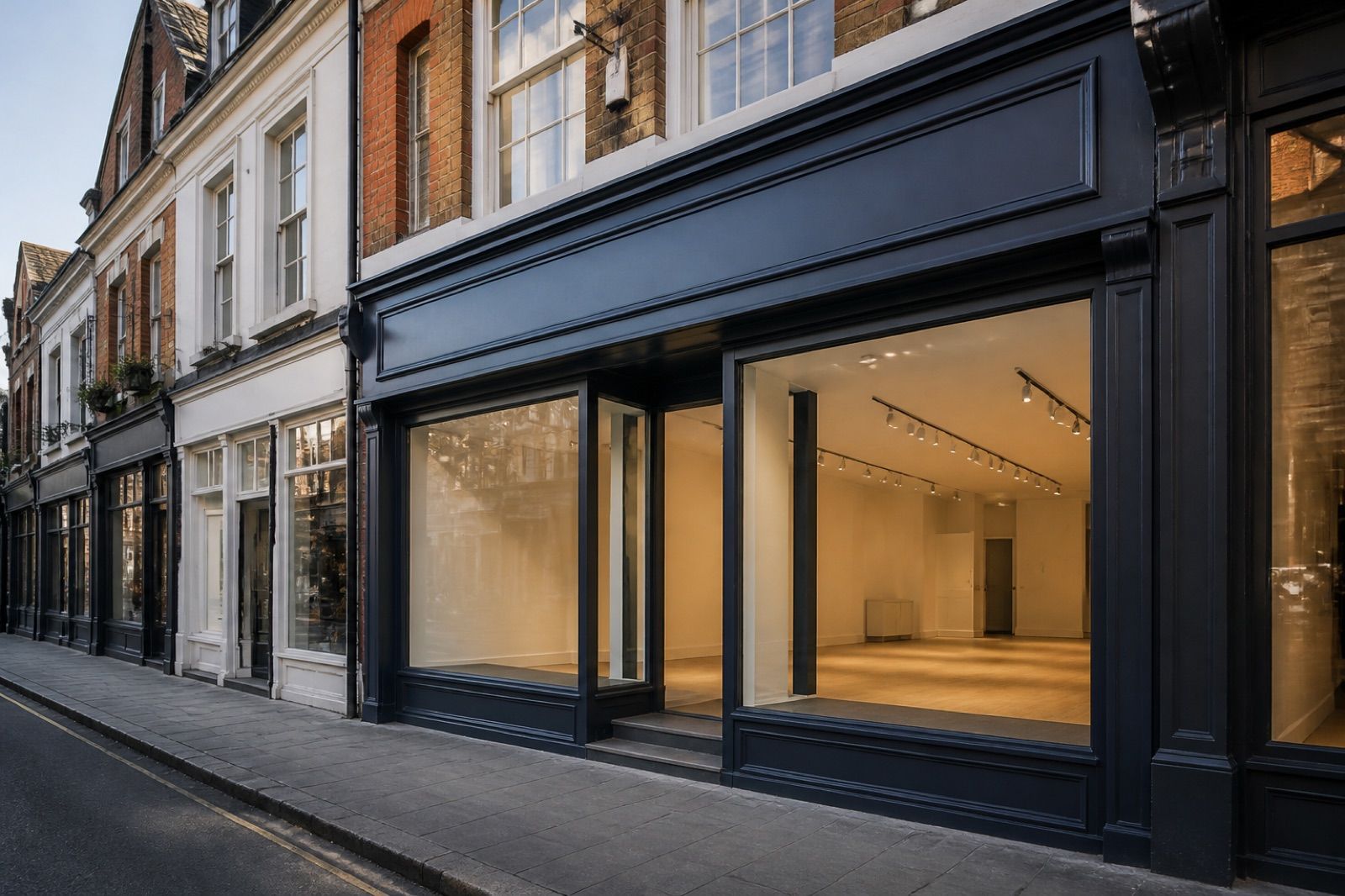
Semi-commercial property is a building that combines commercial space and residential space, usually under a single freehold or long leasehold title. The commercial part earns money from trade; the residential part is somewhere to live. Typical examples on the high street include:
- a shop or convenience store with a self-contained flat above;
- a dental, physiotherapy or veterinary practice with a maisonette on the upper floors;
- an accountant's or solicitor's office with a flat on the second floor;
- a cafe, takeaway or salon with rooms above;
- a pub with owner's accommodation (lenders often treat licensed premises as trading business lending rather than semi-commercial).
Because the building mixes residential and commercial use, it does not fit a standard commercial mortgage or a residential mortgage, and the property type affects which lenders will look at it. Lenders have separate semi-commercial mortgage products for these properties, and their criteria differ more than in most parts of the commercial mortgage market. Lender criteria vary: some count any residential element as making the whole thing semi-commercial; others look at the split of floor space or value.
How owner-occupier lending on a mixed-use building works
For an owner-occupier, the business is the borrower (or the guarantor) and it trades from the commercial part. The flat may be empty, used by an employee, let on an assured shorthold tenancy, or lived in by the owner. One mortgage covers the whole building, so you have one lender, one valuation and one set of terms.
How semi-commercial mortgages work in practice:
- Affordability comes from the trade. The lender looks at your business accounts to see whether profits cover the repayments. Rental income from the flat, if it is let, can add to that income.
- The property is valued as a whole, residential and commercial parts together, with the valuer reporting on both parts and on how easy the building would be to sell.
- The borrower structure is decided early. A limited company borrowing is usually unregulated; an individual or partnership borrowing can be regulated, depending on the flat (see the next section).
- Security is a first charge over the building, normally with personal guarantees from directors. Our guide to personal guarantees explains what that means.
If the building is let to tenants on both floors and your business does not trade from it, that is investment lending (semi-commercial investment mortgages), and lenders assess it on rent cover rather than trading profits. This page focuses on the owner-occupier case; see our owner-occupier mortgages page for premises without a residential element.
When does the flat make it a regulated mortgage?
This is the point most often missed on mixed-use property. The Financial Conduct Authority (FCA) Handbook glossary defines a regulated mortgage contract as one where a lender provides credit to an individual or to trustees, secured by a mortgage on land at least 40% of which is used, or is intended to be used, as or in connection with a dwelling. For a multi-storey building, the FCA's guidance in PERG 4.4 says the land is measured as the total floor area of all the storeys.
On a typical two-storey shop with a flat of the same size above, the residential part is about half the floor area, so it passes the 40% residential-use test. What usually decides whether the loan is regulated is who borrows and who lives there:
- Limited company borrower: the definition covers credit to individuals or trustees, so lending to a limited company is unregulated and falls outside the FCA's regulated mortgage perimeter. This is the structure most owner-occupiers use.
- Individual, sole trader or partnership borrower, and you or a close family member will live in the flat: the loan can be a regulated mortgage contract. We refer these cases to an appropriately authorised firm.
- Individual borrower with the flat let to someone else: exemptions may apply, but the analysis is not ours to make; we refer these too.
We are not authorised by the FCA, and you can check any firm's status on the Financial Services Register. Commercial lending to a limited company is unregulated and falls outside the FCA's regulated mortgage perimeter. Where a deal would be regulated, for example lending to a sole trader or individual, or a property where the borrower or a close family member will live in part of it, we refer it to an appropriately authorised firm.
Semi-commercial mortgage rates, loan to value and fees
Semi-commercial mortgage rates sit between residential and commercial pricing. As a guide, indicative rates for owner-occupied mixed-use property run at about 6.5 to 8.5% a year, indicative, subject to status, accounts and valuation. Where you land in that band depends on the strength of your accounts and trading income, the loan-to-value, the location and condition of the building, and how much of it is residential.
| Term | Indicative range |
|---|---|
| Interest rate | 6.5 to 8.5% a year |
| Loan-to-value (LTV) | Up to 75% |
| Mortgage term | 5 to 25 years |
| Arrangement fee | 1 to 2% of the loan |
| Rate type | Fixed or variable, depending on the product |
All figures are indicative, subject to status, accounts and valuation. Interest rates move with the market, so treat these as a starting point; the interest you pay over the term also depends on the fee and whether you fix. To test repayments on different rates and terms, try our commercial mortgage calculator. You will also need a deposit of at least 25% plus stamp duty, legal and valuation costs; our guide to deposits and costs for business premises lists them. For how pricing works across the wider commercial market, see our costs page.
Lending criteria: what underwriters check before they lend
Lending criteria for a mixed-use mortgage combine commercial and residential checks. Expect a lender's assessment to look at:
- Trading history and accounts: usually two to three years of filed accounts, plus management figures. See how lenders read your accounts.
- Credit: credit searches on the company and the directors, and a review of existing credit facilities. Defaults or County Court Judgments narrow the choice of products but do not always rule a case out.
- The residential part: whether the flat is self-contained with its own entrance, its condition, and who lives there.
- The commercial-to-residential split: some lenders want the commercial element to be the larger share of value; others are relaxed about the mix.
- Valuation: the valuer reports on market value, rental value and saleability of the building as a whole. A down-valuation reduces the loan.
- Deposit and source of funds: where the deposit comes from, and whether any of it is borrowed.
The market spans high-street banks such as NatWest, Barclays, HSBC and Lloyds, which are regulated by the Prudential Regulation Authority and the FCA and offer semi-commercial lending to established businesses, and specialist property finance lenders that take on more unusual mixed-use properties or newer trading histories. Naming a lender describes the market; it does not mean we have a relationship with it.
How hard is it to get a commercial mortgage on a building with a flat?
It is harder than a residential mortgage and a little more involved than a plain commercial mortgage, mainly because fewer lenders offer semi-commercial products and their criteria vary. Common sticking points are:
- a flat with no separate entrance, which some lenders will not accept;
- a short trading history, under two years, which limits the product range;
- a building in poor condition, or with a flat that is not habitable;
- a mixed-use building where the business does not yet trade from the commercial space.
None of these is a hard no across the whole market. The thing to consider before you apply is presentation: set out the building, the business and the borrower clearly before any application goes in, so it reaches lenders whose criteria fit and each mortgage application has a real chance. Understanding each lender's appetite is most of what a specialist mortgage broker does on semi-commercial mortgages, and it is why we ask for so much up front.
Semi-commercial term loans versus bridging finance
A semi-commercial mortgage is long-term finance for a building that is in usable condition. Sometimes the property needs work first: a flat without a kitchen, a shop with no trading fit-out, or a building bought at auction where completion is due within weeks. Term lenders often will not lend on that.
In those cases, bridging loans can fund the purchase and works, and the bridging is then repaid by refinancing onto a semi-commercial mortgage once the building is ready and the business is trading from it. Indicative bridging rates are 0.70 to 0.95% a month, with loans up to 70 to 75% gross of value, indicative, subject to status, accounts and valuation. Bridging is short-term and costs more, so the exit to a term loan has to be realistic from day one. Our business premises bridging page explains how it works.
Larger conversion schemes, such as adding flats above a shop, move into development finance, which is a different market and outside what this page covers. Bridging loans, development finance and semi-commercial mortgages are often discussed together, but for an owner-occupier the order is usually bridging first (if needed) and the term loan second.
How we arrange finance for your shop with a flat above
We are a broker (arranger and introducer), never a lender. For semi-commercial premises we:
- get the facts on the building, the floor area of each part, who lives in the flat and how you plan to borrow;
- check whether the case sits outside the regulated perimeter, and refer it to an authorised firm if it does not;
- approach the lenders whose criteria fit the building and the business, and present the case;
- help you compare the terms that come back and work through to completion with your solicitor.
If you would like to speak to us about semi-commercial properties, start with the building details, the residential and commercial floor areas and your latest accounts. If you are still deciding whether to buy, our guide to renting versus buying your premises sets out the numbers to compare. Nothing on this page is financial, tax or legal advice.